How news reaches people today
Each office posts on its own Facebook page, radio reads out what it is sent, and circulars hang as PDFs. A message reaches whoever happens to be on the right page at the right time.
Three things nobody can do today: warn everyone in one state within a minute, deliver news to every household that wants it, and raise a concern about an office without being recognised.
Three jobs, one app
-
1
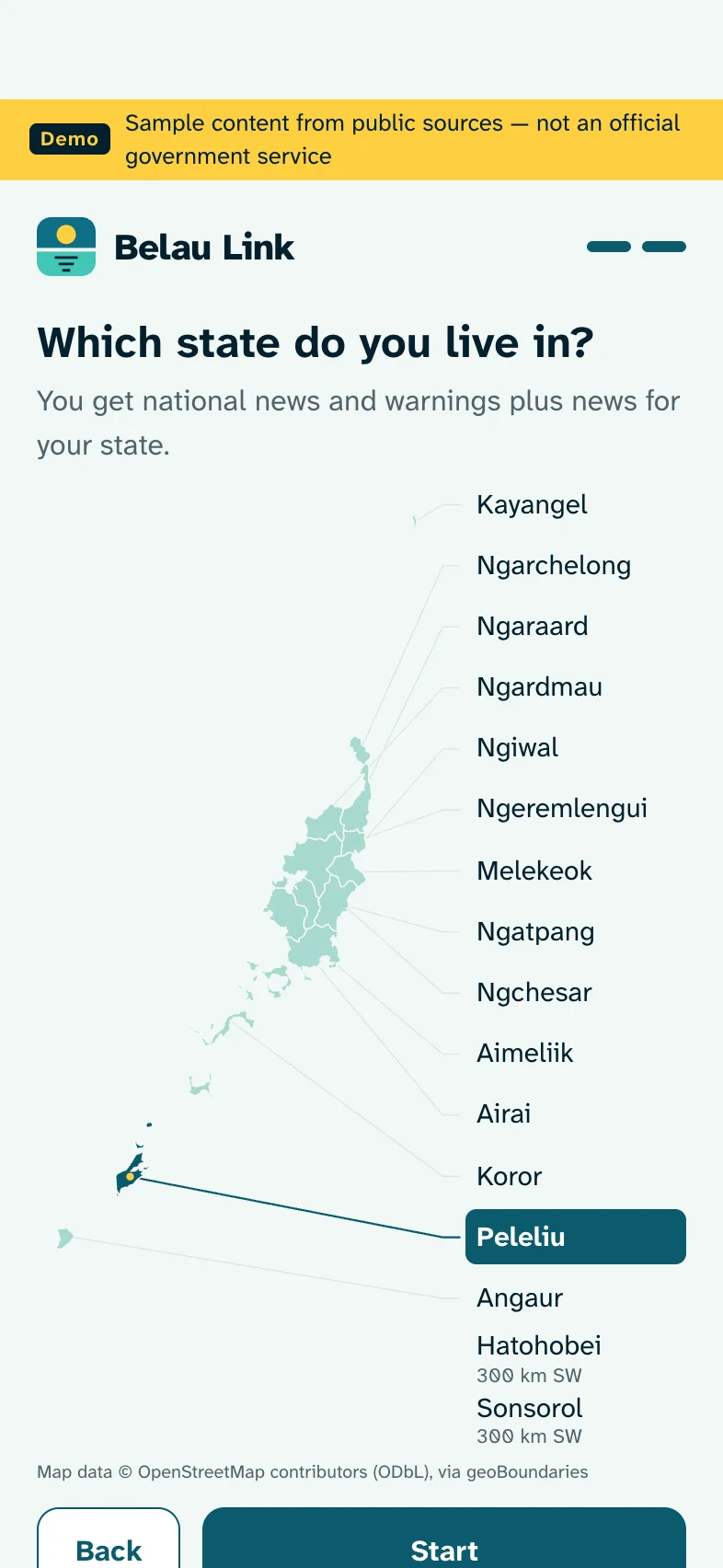
Choose your state once
Pick your state on the map. From then on you get national news and warnings plus everything for your state. There is nothing else to set up.
-
2
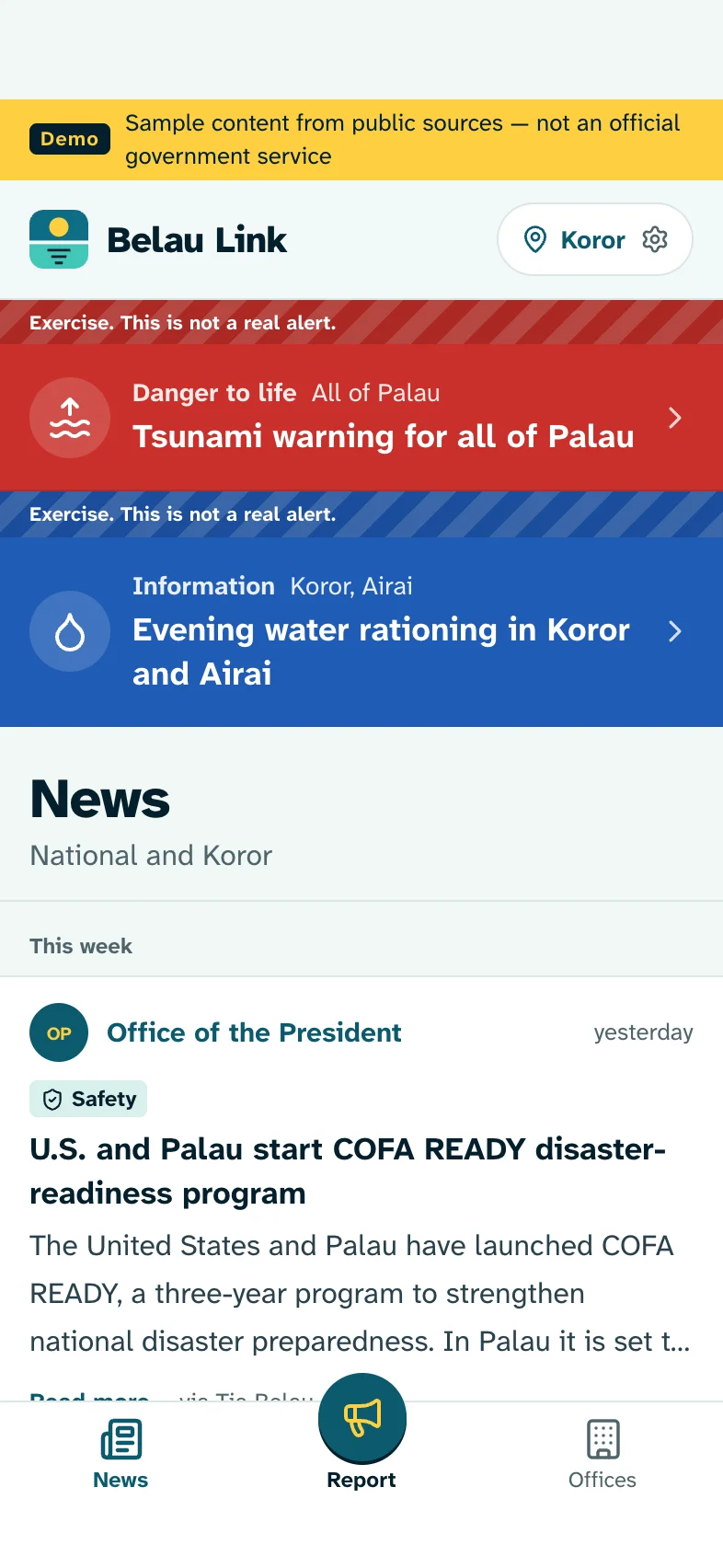
News from every office, in one feed
Posts from the Office of the President, the ministries, NEMO, PPUC and the state governments, newest first. Each post says what it is about and where it came from.
-
3
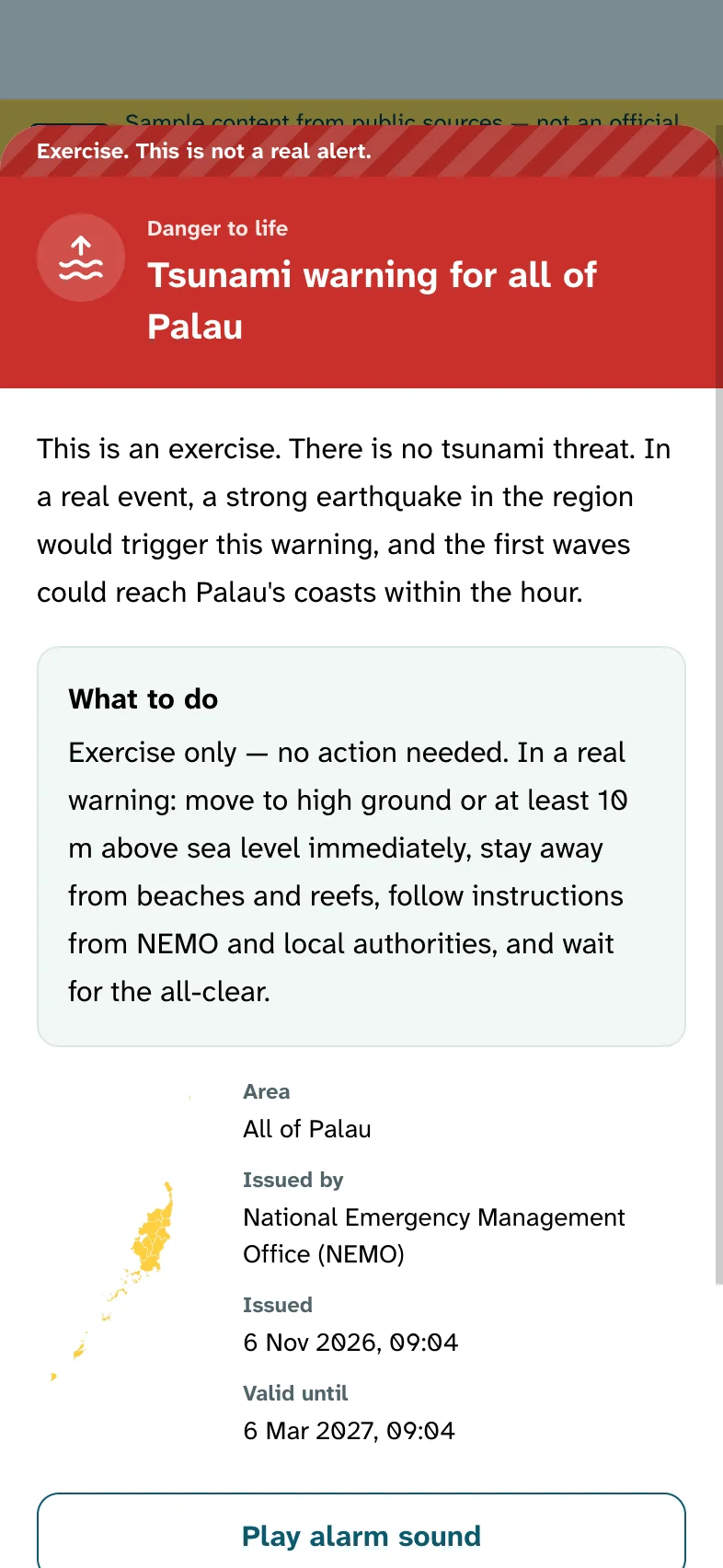
Warnings that cannot be missed
Four levels following CAP 1.2, the format radio stations and neighbouring countries already read. A danger-to-life alert comes with an alarm tone. Exercises are hatched, so a drill is never mistaken for the real thing.
-
4
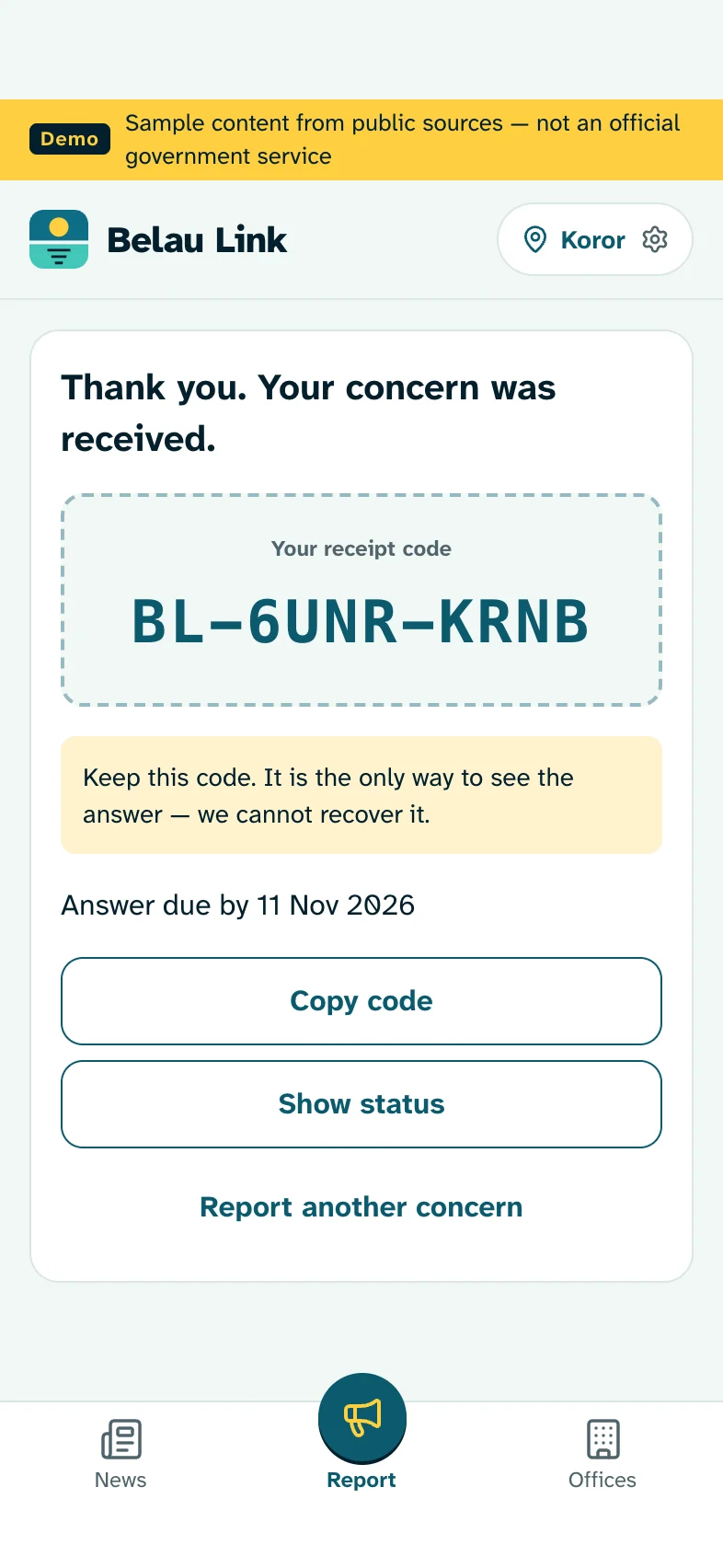
A concern, without giving your name
Report a problem in under two minutes. The receipt code is the only key: no account, no phone number, no IP address stored. The responsible office has a deadline, and the statistics per office are public.
Built for NEMO's way of working
Warnings from the Pacific Tsunami Warning Center and the National Weather Service in Guam arrive as drafts. A NEMO officer approves them; a danger-to-life alert needs a second approver, except for a confirmed tsunami bulletin, where minutes count.
Until there is an official channel, a public page mirrors what the US warning centres publish for Palau, refreshed every fifteen minutes.
…Every state has its own channel
A typhoon warning for Kayangel reaches Kayangel. A water notice for Koror and Airai reaches Koror and Airai. National news reaches everyone, including the Southwest Islands three hundred kilometres away.
Try it yourself
The demo is the real app with sample content from public sources. It runs in any browser and on five-year-old phones.
- Open the tsunami exercise and play the alarm tone.
- Report a concern and keep your receipt code.
- Look up the answered example concern BL-7K4M-29QX.
- Switch to Palauan and see how missing translations are marked.
Or scan to open it on your own phone.
For OATS: how it runs
- Owned by Palau
- Runs on Cloudflare Workers, D1 and R2 in an account that belongs to the Government of Palau. The operator is an administrator under contract and can be replaced.
- Open source
- The government can review every line before launch, run it itself or hand it to someone else.
- Open standards
- CAP 1.2 for alerts. Web Push, Firebase Cloud Messaging and Apple Push for delivery. SMS for alert levels through a local gateway.
- Private by construction
- Concerns are not linked to devices in the database, and a test checks this on every build. No analytics from third parties.
- A twelve-week pilot
- From a memorandum of understanding to a soft launch with an alert exercise in week nine.
Who is behind it
Belau Link is an independent project by Max Vogt, a software developer from Karlsruhe, Germany. He builds production systems — from AI document pipelines to a complete ERP for a manufacturing company — with a focus on security and clear handover to the people who run them. Belau Link is not tied to any company. The code is open, and the accounts, data and domain of a live service would belong to the Republic of Palau.